
 en
en 中文简体
中文简体 русский
 Español
 Deutsch
 Polskie
 REQUEST A QUOTE


Durability secrets of livestock breeding mold technology
Modern livestock production increasingly depends on equipment that can withstand repeated use, outdoor exposure, cleaning, impact, and demanding farm environments. In this context, livestock breeding mold technology provides an efficient way to manufacture hollow agricultural components with consistent dimensions and practical structural strength. Rotational molding is particularly suitable because it can produce complex hollow shapes without the geometric limitations often associated with conventional tooling. Mold sections can also be assembled from two or more parts, giving designers greater freedom in product size and configuration. For farms that require reliable feeders, water containers, storage tanks, and other animal-management equipment, durable farm mold design is therefore closely connected with long-term production stability.
Rotomolded Animal Feeders and Feeding Equipment
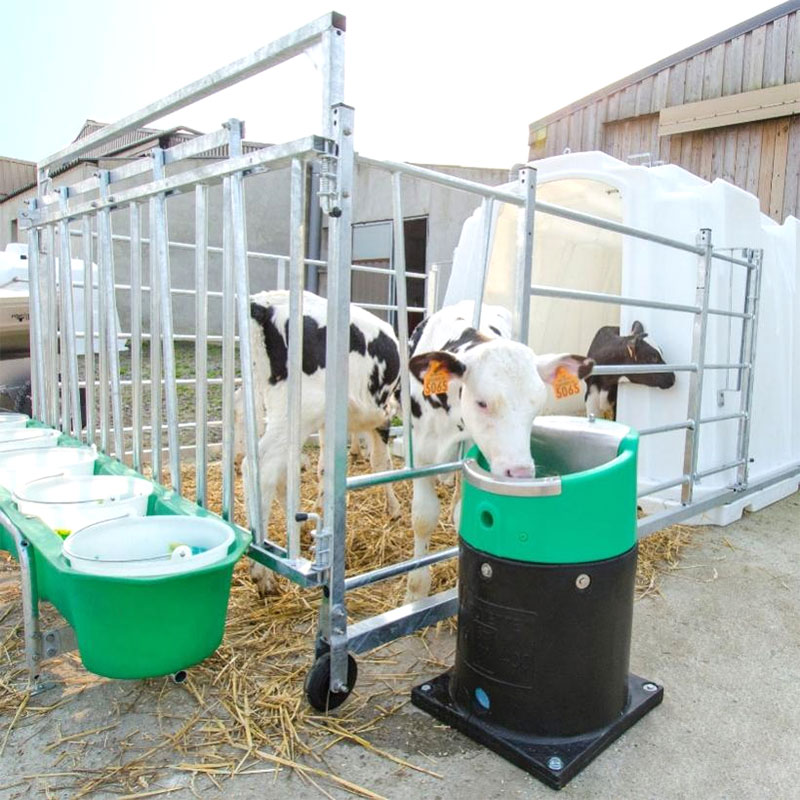
Animal feeders are among the most demanding applications for rotational molding because they must combine structural strength, smooth internal surfaces, easy cleaning, and resistance to repeated handling. Rotomolded animal feeder tooling is developed around the final feeder geometry, including wall transitions, corners, openings, mounting points, and access areas. The rotational molding process distributes plastic material throughout the mold as it rotates and heats, allowing manufacturers to form hollow feeder bodies with relatively uniform walls and fewer joints.
A major advantage of this category is design flexibility. Feeders may be produced in different capacities, widths, shapes, and colors without fundamentally changing the manufacturing concept. Material can be replaced directly between molding cycles when different colors are required. This makes the process useful for agricultural equipment manufacturers serving farms with different operational requirements. Compared with rigid fabricated feeders, rotomolded versions can offer integrated rounded surfaces and fewer seams, reducing areas where feed residue and moisture may accumulate.
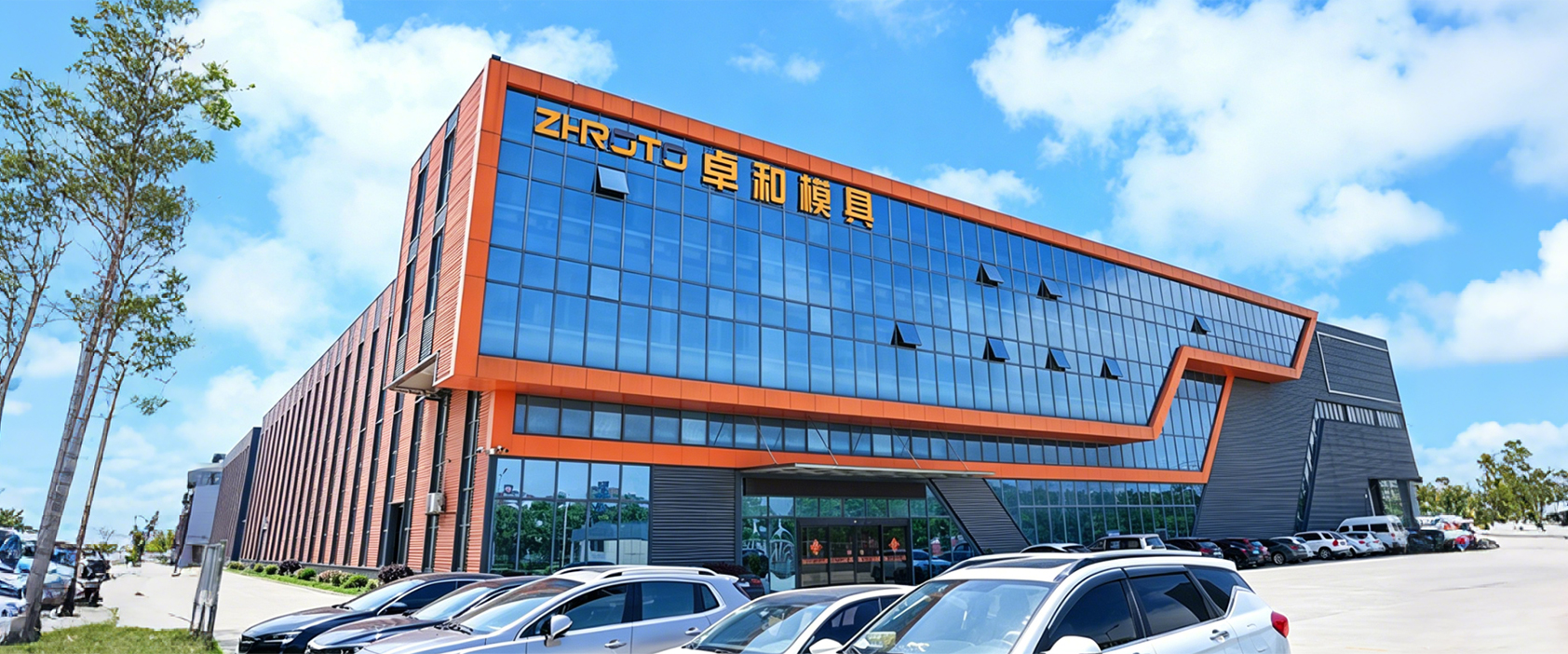
For this application, mold durability depends on accurate machining, appropriate mold construction, controlled thermal performance, and careful treatment of high-stress areas. Jiangsu Zhroto Mould Co., Ltd. provides mold design, CNC manufacturing, trial validation, inspection, and production support for agricultural applications. Its engineering workflow begins with product requirements and continues through 3D modeling, mold confirmation, precision machining, sample validation, and final acceptance.
- Rounded geometries can improve cleaning convenience and reduce residue-retention areas.
- Hollow construction provides useful strength without requiring a solid heavy structure.
- Custom mold configurations allow feeders to be adapted to different animal-management systems.
- Color changes can be achieved by changing the molding material between production cycles.
Rotomolded Water Tanks and Agricultural Containers
Water tanks and agricultural containers represent another important category of agricultural plastic equipment. These products require dependable containment, dimensional consistency, resistance to outdoor conditions, and practical installation features. Rotational molding is well suited to tanks because the process can create large hollow products with complex curves and integrated structural features. Mold sections can be configured around the required tank geometry, allowing manufacturers to develop compact products as well as large-capacity containers.
The durability of tank tooling is strongly influenced by surface quality and dimensional accuracy. Poorly controlled mold surfaces can affect product appearance, release behavior, and repeatability over many cycles. Proper engineering also considers access openings, fittings, ribs, mounting areas, and areas where the finished product may experience repeated handling. Unlike feeder molds, tank molds place greater emphasis on maintaining consistent wall formation over larger surfaces and preserving dimensional stability during repeated thermal cycles.
Jiangsu Zhroto Mould Co., Ltd. has experience in large-scale mold machining and complex curved-surface manufacturing. Its capabilities cover both conventional gas-heated rotomolding machines and newer electric-heating systems. Since 2023, the company has developed electric-heated rotomolding capabilities featuring more precise temperature management, independent heating zones, and improved process control. These capabilities place greater demands on mold thermal performance and engineering accuracy, but they can also support more stable manufacturing.
Key Durability Considerations for Tank Tooling
| Product category | Main requirement | Important mold characteristic | Typical application |
| Animal feeders | Impact resistance and easy cleaning | Smooth surfaces and reinforced geometry | Cattle, sheep, and livestock feeding |
| Water tanks | Reliable containment and outdoor durability | Stable large-surface geometry | Farm water storage |
| Agricultural containers | Handling and storage reliability | Accurate dimensions and practical release design | Feed, supplies, and farm materials |
Custom Agricultural Equipment and Complex Hollow Components
The third category covers customized agricultural components designed for specific farm operations. These may include storage units, float bodies, protective housings, specialized containers, and other large hollow products. Here, livestock breeding mold engineering is less about producing a standard product and more about translating a particular functional concept into a manufacturable rotational molding solution.
The principal advantage is geometric freedom. Rotational molding can accommodate complex curves, hollow sections, and relatively large dimensions while using molds composed of multiple sections when necessary. This flexibility enables agricultural equipment designers to integrate product-specific functions directly into the mold concept. For customized equipment, durable farm mold design must address not only service conditions but also manufacturability, material distribution, demolding, thermal behavior, and production repeatability.
Jiangsu Zhroto Mould Co., Ltd. supports this category through an integrated development process. The company can work from an initial product concept, existing drawings, or a newly developed rotomolded product. Engineers evaluate the application, dimensions, structure, and production requirements before creating detailed CAD models and confirming the mold configuration. CNC machining, trial production, sample evaluation, dimensional inspection, and technical support are then incorporated into the project workflow.
- Review the product concept, operating environment, dimensions, and production objectives.
- Optimize the product structure for rotational molding performance and manufacturability.
- Develop the three-dimensional engineering model and confirm the mold construction.
- Manufacture the tooling with precision machining and conduct mold trials.
- Inspect samples, verify dimensional accuracy, and provide production optimization guidance.
Material, Heating, and Manufacturing Factors Behind Mold Longevity
Long mold service life is not determined by one feature alone. It results from the interaction of engineering design, manufacturing precision, material selection, heating conditions, release behavior, inspection, and maintenance. In agricultural applications, tooling may be exposed to frequent thermal cycling and demanding production schedules. A well-engineered mold should therefore maintain its geometry and surface condition throughout repeated production cycles.
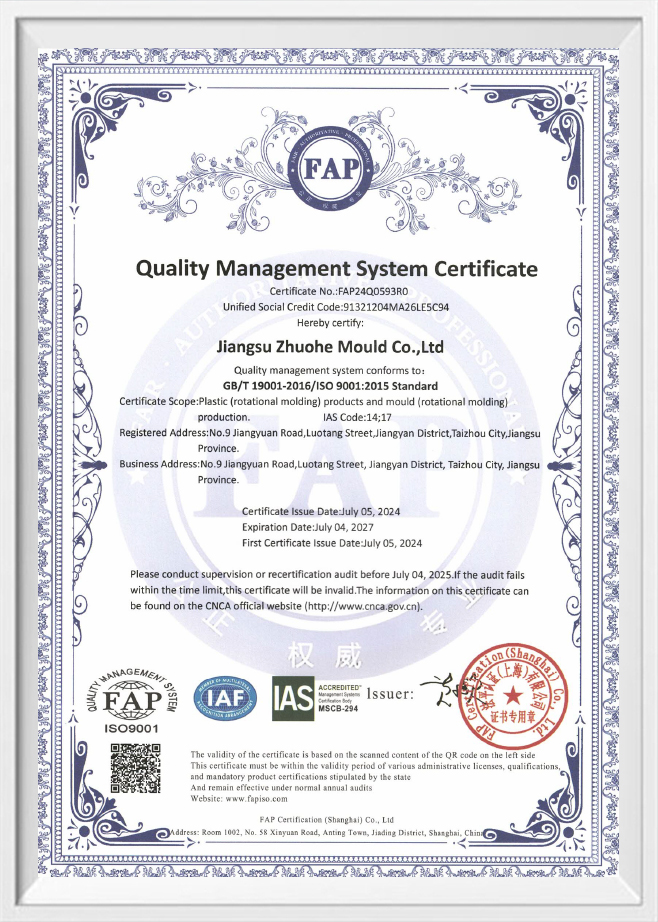
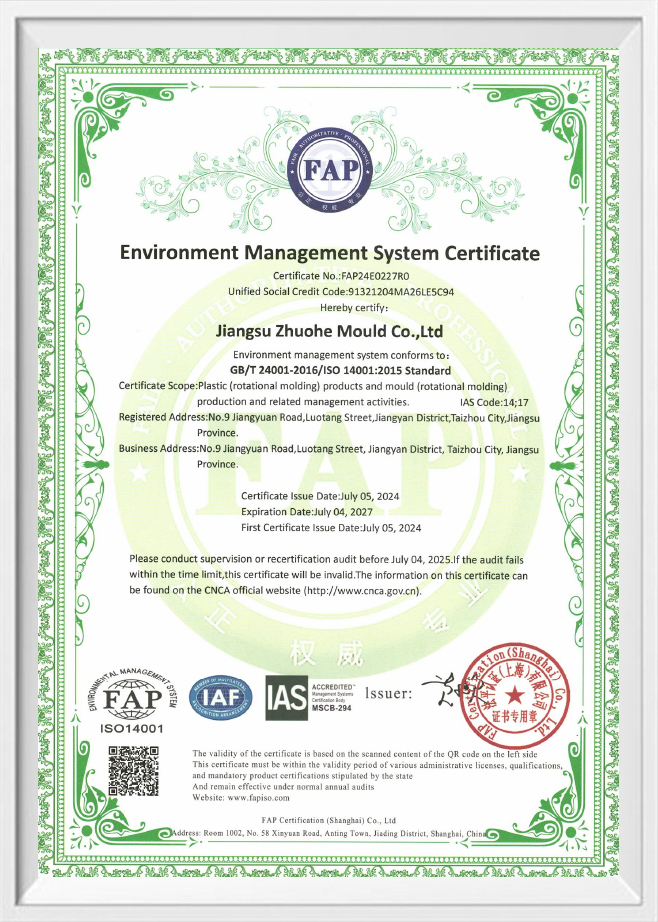
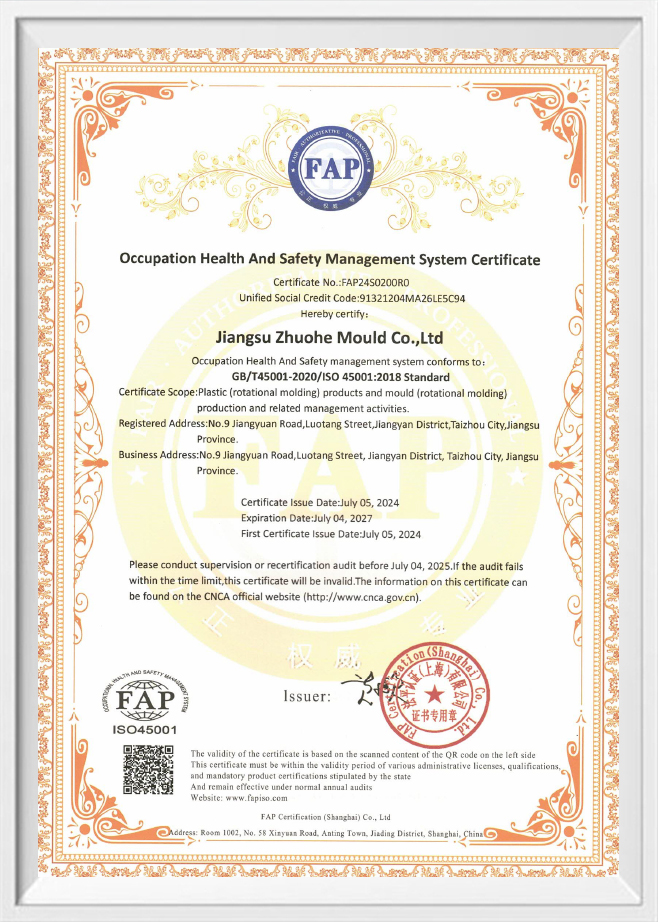
The company has an annual output exceeding 800 mold sets and provides integrated services from engineering development through production support. Its ISO 9001:2015, ISO 14001:2015, and ISO 45001:2015 management system certifications further support a structured approach to quality, environmental management, and occupational safety. For customers requiring agricultural plastic equipment, this integrated capability can reduce communication gaps between mold design, manufacturing, trial validation, and final production.
Electric-heated rotomolding introduces another important consideration. More precise temperature management and independent heating zones increase the importance of mold thermal characteristics and manufacturing consistency. According to the company's technical capabilities, its electric-heated solutions can support temperature control accuracy of approximately 1 to 2 degrees Celsius, thermal efficiency above 95 percent, and reduced energy consumption under suitable production conditions. These improvements can contribute to more controlled processing when the mold is correctly designed for the heating system.
How to Select a Durable Livestock Mold Solution
Selecting a mold should begin with the final product rather than the tooling alone. Feeders, tanks, and customized agricultural components have different loading patterns, cleaning requirements, dimensions, and production expectations. A reliable supplier should therefore evaluate the complete application before recommending a mold configuration. A suitable livestock breeding mold should provide the necessary geometric flexibility while supporting repeatable production and manageable maintenance.
The most effective approach combines product engineering with manufacturing expertise. ZHROTO Mould provides mold maintenance advice and ongoing technical assistance after delivery, helping customers address production optimization and future improvement requirements. This is particularly valuable when agricultural equipment is produced continuously, because tooling performance directly affects production consistency, product quality, and operational efficiency.
Frequently Asked Questions
Q1: What is the main advantage of a livestock breeding mold?
The main advantage is the ability to manufacture hollow livestock equipment in complex shapes with flexible dimensions. Rotational molding also allows material colors to be changed between production cycles, supporting different product specifications without changing the fundamental manufacturing method.
Q2: Why is rotomolded animal feeder tooling suitable for farm equipment?
Rotomolded animal feeder tooling supports rounded, hollow feeder designs with relatively consistent walls and fewer joints. These characteristics can simplify cleaning, handling, and product customization while providing a practical solution for repeated agricultural use.
Q3: What makes durable farm mold design important?
Durable farm mold design helps maintain dimensional accuracy, surface quality, and production stability during repeated thermal cycles. Proper engineering also improves mold release, reduces unnecessary tooling wear, and supports consistent finished-product quality.
Q4: Can Jiangsu Zhroto Mould Co., Ltd. develop customized agricultural molds?
Yes. Jiangsu Zhroto Mould Co., Ltd. provides customized rotational molding solutions based on product concepts, drawings, or new product development requirements. Its services cover engineering evaluation, 3D modeling, mold manufacturing, testing, inspection, delivery, production support, and maintenance guidance.
Q5: Can these molds work with electric-heated rotomolding machines?
Yes. The company has developed electric-heated rotomolding mold capabilities since 2023. These solutions are designed around more precise temperature control and zoned heating requirements, making appropriate mold engineering particularly important for stable production.
 +86-18006248936
  ricky.t@zhroto.com
  No.9 Jiangyuan Road, Luotang Street, Jiangyan District, Taizhou City,Jiangsu Province, China